Monday, March 24, 2008

This week in English 12AP

THis week we will continue to read and analyze Hemingway's short stories "The Killers" and "The Short Happy Life of Francis Macomber."

If you did not pick up a copy of the story on Thursday, you can access it here.

http://www.duke.edu/~ss57/macomber.pdf

We will also be reviewing poetic analysis again in class. We will be trying to find the "deeper meanings" in poetry, those elements and themes which convey universal applications.

Poetic elements and analysis questions we will review this week are:

Persona- Who is the speaker?

Setting - What is the occasion?

Tone / Theme - What is the central idea or purpose of the poem?

Syntax - What is the diction, structure, development?

Development - How does imagery, metaphor, simile, juxtaposition allow meaning to develop?

We will be re-reading Frost's "Out, Out"- , "(p. 178) "Dulce et Decorum Est" by Wilfred Owen (p 7-8), William Carlos Williams "The Red Wheelbarrow" and "Constantly risking absurdity" by Lawrence Ferlinghetti (17-18).

We will also be discussing reading assignments for the remainder of the short story/ poetry unit.
Everyone will need to take a copy of the short story anthology from the classroom.

Update 3/24: I have reviewed the anthology. The following short stories will be required reading for this week and next week:

"The Story of an Hour" by Kate Chopin (p. 63)

"The Yellow Wallpaper" by Charlotte Perkins Gilman (p. 82)

"The Jilting of Granny Weatherall" by Katherine Ann Porter (p. 206)

"Cathedral" by Raymond Carver (p. 388)

That's four short stories.

We'll take Chopin, Gilman & Porter as homework for 3/27.

Review women's roles and themes in each one. Look at questions of identity, gender roles and feminism in each one. There will be an essay assigned to compare these three stories under this thematic evaluation.


Literary Notes.....


Today ( 3/24) is the birthday of poet, publisher, and bookstore proprietor Lawrence Ferlinghetti, (books by this author) born in Yonkers, New York (1919). His Italian father died while his French-speaking mother was pregnant, and his mother had a nervous breakdown and went to a mental hospital the year after he was born. He was sent to live with an aunt, who divorced her husband and took Lawrence to France. Four years later, she returned to New York, placed him in an orphanage until she could find work, then brought him into the rich household where she had found a position as governess. She disappeared and later died in an asylum, and the family she worked for adopted and began to educate the boy with classic literature.

After college, he served in the Navy during World War II. He was sent to Nagasaki shortly after the blast and said, "Before I was at Nagasaki, I was a good American boy. I was an Eagle Scout; I was the commander of a sub-chaser in the Normandy Invasion. Anyone who saw Nagasaki would suddenly realize that they'd been kept in the dark by the United States government as to what atomic bombs can do." He became staunchly antiwar. While in graduate school in New York and Paris, he began to write poetry and to draw and paint. He moved to San Francisco and wrote poems, book reviews, and columns for various Bay Area publications, including the City Lights magazine published by Peter Martin.

In 1955, Ferlinghetti started a publishing company, which that year published his first book of poetry, Pictures of the Gone World. He hoped to publish volumes slim enough that workers would be able to slip them into their pockets to read during their lunch breaks. Later that year, he went to a poetry reading called "Six Poets at the Six Gallery," organized by the poet Kenneth Rexroth. There he saw a poet named Allen Ginsberg read a new poem called "Howl." Ferlinghetti was deeply impressed, and after the reading, he sent Ginsberg a telegram that said, "I greet you at the beginning of a great career. When do I get the manuscript?"

The next year City Lights published "Howl," which was seized on its way back from the London printer by customs officials for violating obscenity laws. Ferlinghetti was put on trial for printing and selling lewd and indecent material. The ACLU defended him and he was acquitted, and the publicity from the trial benefited his bookstore and helped "Howl" to become one of the most widely read poems of the century. Ferlinghetti said, "The San Francisco [customs office] deserves a word of thanks. It would have taken years for critics to accomplish what the good [customs office] did in a day." From then on, he could publish what he wanted.

Saturday, March 15, 2008

Paradigms: Scientific or Literary?


We've had an interesting discussion about paradigms in literature and literary analysis. The way in which we interpret literature has changed from that of an authority dictating meaning to us, to a variety of meanings, public interpretation and personal interpretation.

And when Charles sits on his desk, breaking the student paradigm of constraint behind a sturcture, he has interpretive epiphanies....coincidence?


(I hear you: is she making this all up?)
For your consideration.....

As we all know,things change. Or as our man Yeats said;

"Things fall apart, the centre cannot hold
Mere anarchy is loosed upon the world
The blood-dimmed tide is loosed, and everywhere
The ceremony of innocence is drowned;

The best lack all conviction, while the worst
Are full of passionate intensity.
Surely some revelation is at hand;
Surely the Second Coming is at hand.
"

Was Yeats talking of paradigms shifting in Ireland? In the world?

Speaking of paradigms....this is where the term originated: (from wikipedia & noelweidbrocht.com)

Paradigm shift, sometimes known as extraordinary science or revolutionary science, is the term first used by Thomas Kuhn in his influential 1962 book The Structure of Scientific Revolutions to describe a change in basic assumptions within the ruling theory of science. It is in contrast to his idea of normal science.

It has since become widely applied to many other realms of human experience as well even though Kuhn himself restricted the use of the term to the hard sciences. According to Kuhn, "A paradigm is what members of a scientific community, and they alone, share.” (The Essential Tension, 1997). Unlike a normal scientist, Kuhn held, “a student in the humanities has constantly before him a number of competing and incommensurable solutions to these problems, solutions that he must ultimately examine for himself.” (The Structure of Scientific Revolutions).

A scientist, however, once a paradigm shift is complete, is not allowed the luxury, for example, of positing the possibility that miasma causes the flu or that ether carries light in the same way that a critic in the Humanities can choose to adopt a 19th century theory of poetics, for instance, or select Marxism as an explanation of economic behavior. Thus, paradigms, in the sense that Kuhn used them, do not exist in Humanities or social sciences. Nonetheless, the term has been adopted since the 1960s and applied in non-scientific contexts.


So as you return your tray table to it's locked and upright position, think of any paradigms that may have shifted in Kafka's Metamorphosis, and as we read Hemingway, look for evidence of paradgims that may or may not have shifted during travel...

Today in Literature: Have you read Julius Ceasar? she asked.


Today is the infamous Ides of March. Two thousand fifty-two years ago on this day, the Roman emperor Julius Caesar was stabbed to death by senators who called themselves the Liberatores (Liberators) and claimed they were preserving the integrity of the Roman system. Although Caesar ostensibly refused to be named king, he had no qualms about stamping his face on coins (a spot previously reserved for gods), and he happily assumed the title "dictator for life" in February of 44 B.C.E., just a month before his assassination. The most famous of the Liberators is Marcus Brutus, a man personally connected to Caesar. Brutus's mother, Servilia, was one of Caesar's lovers, and Caesar singled Brutus out as a young man of promise and gave him a government position. It's not certain why Brutus conspired to kill Caesar, but the young man did come from a family of anti-authoritarians — his ancestor Junius Brutus overthrew the last king of Rome in 509 B.C.E.

Of course, William Shakespeare wrote a play about this. In it, Ceasar is told to "Beware the Ides of March"(Act 1, sc.ii) because, well, something bad was going to happen. Like his bff Brutus was a backstabber. Literally.
After Brutus had killed Ceasar, he gave a big funeral speech. "I come to bury Ceasar, not to praise him" he told the mob. "I loved him, but loved Rome more" he also said. Deflection: a useful political tool.

Have we witnessed any other political deflections in the Shakespearean works read so far this year?


NEXT UP: Ernest Hemingway


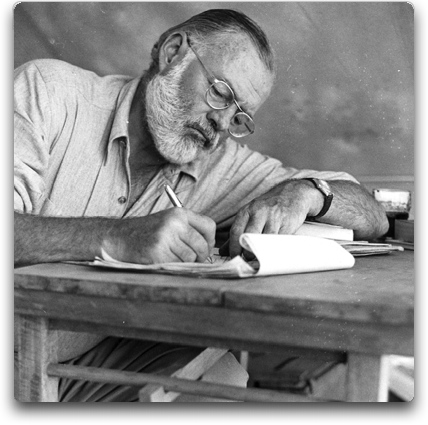
Ernst Hemingway (1899-1961) was an expatriate American writer. His writing career started with a stint as reporter for the Kansas City Star in 1917. His short stories and novels are noted for their understated and succinct writing style, which evolved from his journalistic style. He once said that his writing was influenced by the Star's style guide : "Use short sentences. Use short first paragraphs. Use vigorous English. Be positive, not negative."

Hemingway's novels include "The Sun Also Rises", "For Whom the Bell Tolls" , "A Farewell to Arms" and "The Old Man and the Sea."


Hemingway lived and wrote in Paris after World War I. Many of his novels focus on Americans living in Europe after the war. His novels also include manly activities as bullfighting, the running of the bulls in Pamplona, and hunting trips. His writing is categorized by economy in writing, featuring stoic male protagonists who exhibit what is known as "grace under pressure." His writing -the style, characters and themes- had a great influence on the development of modern fiction. He was a contemporary of F. Scott Fitzgerald, Gertrude Stein, and Ezra Pound ( remember him? Imagists?) who was Hemingway's artistic mentor for a time. Hemingway said"Ezra was right half the time, and when he was wrong, he was so wrong you were never in any doubt about it."

The short stories of Hemingway we will read are:

The Snows of Kilimanjaro
The Killers
The Short happy Life of Francis Macomber

As we read these short stories ( actual short stories, not novellas like Kafka's Metamorphosis), watch for how Hemingway uses economy of language to tell his story, to describe people and settings, and how his use of dialogue fleshes out a story or character.

We will also evaluate whether or not Papa ( Hemingway's nickname) stuck to his Kansas City Star style manual guidelines, using short sentences, short first paragraphs, vigorous English.

Since these stories are so short, we will try to read & annotate them in one sitting, with discussion and analysis for the remainder of the week.

Wednesday, March 12, 2008

Socratic Circles and a Birthday of Note.


Once upon a time, Socrates had an idea.

If he allowed students to have structured dialogues between themselves, he theorized, they might, just might, come up with some intelligent ideas of their own in the discussion.

Socrates believed that it was important for students to think for themselves instead of just having him fill their head with alleged "correct" answers.

A good Socratic seminar suspends biases and allows students to listen and question each other based on a discussion. The discussion is exploratory; that is, there is no specific "end point" that has to be reached in the discussion.


In today's discussion, several good points were made throughout the discussion. Characters, symbolism and the idea of authority were discussed, along with whether or not cockroaches have eyelids.

A character development question was raised: Why didn't Gregor Samsa leave?

So, what were your opinions of the Socratic Circle? Do you have any suggestions on how it could have been improved? Did you learn anything from this experience?

For Homework:

We will have our
Irish Literary Festival on Friday.
If you can find a poem, literary piece, or biographical information on an Irish author, bring it along.


Today is also the birthday of Jack Kerouac, born Jean-Louis Kerouac in Lowell, Massachusetts (1922). He was part of the "Beat Generation," and he came up with the name. He said, "To me, it meant being poor, like sleeping in the subways ... and yet being illuminated and having illuminated ideas about apocalypse and all that." Later, Kerouac decided that "beat" stood for "beatific."

His parents were from French-speaking Quebec, and he did not start learning English until grade school. He skipped second and third grades, and as a 16-year-old senior, he ditched class in order to go alone to the public library and read what he wanted: Hugo, Goethe, Hemingway, William Saroyan, Thomas Wolfe, history books, the Encyclopedia Britannica, and books of chess problems. He was a good football player and received a scholarship to Columbia University, but he broke his leg in the first season and didn't play anymore. He dropped out of Columbia, joined the Merchant Marine and then the Navy, and was given a psychiatric discharge after only two months, having been labeled as a "schizoid personality." The next fall, he went back to Columbia where he dropped out again almost immediately, but kept his apartment near campus and it became a gathering place for young intellectuals. During that time, he met Allen Ginsberg, William S. Burroughs, Carl Solomon, Neal Cassady, and others who would help found the Beat Movement.

He spent the next seven years hitchhiking around the United States and Mexico, and in 1949 he and his friend Neal Cassady drove a Cadillac limousine from California to Chicago, going over 100 miles an hour on two-lane roads until the speedometer broke. In 1951, he sat at his kitchen table, taped sheets of Chinese art paper together to make a long roll, and wrote the story of Cassady and their trips. It had no paragraphs and very little punctuation. Allen Ginsberg called it "a magnificent single paragraph several blocks long, rolling, like the road itself." It took him only three weeks to complete and became his novel On the Road (1957).

Friday, March 7, 2008

Kafka and Zeno's Paradox


As you know, this is an English class, not a Math class. But sometimes, especially in works of sureralism or magical realism, philisophical or mathmatical paradoxes can act as supporting actors in framing the text. Think of how Zeno's Paradox could frame some of the the ideas of conflict in "The Metamorphosis"
Zeno's Paradox may be paraphrased as follows:
Suppose I wish to cross the room. First, of course, I must cover half the distance. Then, I must cover half the remaining distance. Then, I must cover half the remaining distance. Then I must cover half the remaining distance . . . and so on forever. The consequence is that I can never get to the other side of the room.
What this actually does is to make all motion impossible, for before I can cover half the distance I must cover half of half the distance, and before I can do that I must cover half of half of half of the distance, and so on, so that in reality I can never move any distance at all, because doing so involves moving an infinite number of small intermediate distances first.
So, we never get anywhere.
Motion is impossible.
See what biographical information you can unearth about Kafka that might contribute to the tone of "The Metamorphosis." How would social,political, and personal factors convey Kafka's view of life through his literature?
After watching the Salvador Dali video in class, I was astounded at the way motion was used in conjunction with the surealistic images. What did you think? Did Dali convey a message or was it all unconscoius mumbo-jumbo?

The Theory of Everything: From Thursday's class


Due to popluar demand, here is the info from Thursday.


REMINDER: Take home test due Monday. Answer 2 questions: 1 Poetry and 1 Macbeth.


HOMEWORK: Read Kafka's "The Metamorphosis" and annotate.


Literary Theory: Paradigm
*A framework of generally accepted assumptions and perspectives
*An example or pattern
*Relationship to accepted ideas is understood within the profession
*Allows research without continual justification of methodology (ex. Copernicus)

Paradigms in Literature
*Can you get meaning from a text through a paradigm?
*Can using a “methodology” lead to authentic interpretation?


Paradigm vs Theory
*
Theory= nothing “goes without saying”
*Each and every term must be defined and re-defined contextually
*Terms such as “gender politics”, “political propaganda”, “phallocentric” – reflective of theory


Why Theory?
*
No consensus exists about a canon
*People, critics (yes, they are people too) theorize in analysis
*Analysis & theory replace paradigms


Three questions when readingWhy, What, How?

*Why read literature?
*Literature attempts to bring together in a system of values which transcend class, economy, race, gender


Theory of Everything


*What should we read?
*Do we want to change the world or merely learn about it?


How should we read?

*Is interpretation the same for every reader?
*Private associations and public meaning
*Persona / person